
TikTok SEO: How Keywords and Metadata Impact Your Visibility
Last Updated:
Table of Content


Customers search TikTok now much like they used to search Google by directly typing things like "best coffee shop near me" or "how to fix a leaky faucet" into the app and tapping videos that answer them. If your content isn't optimized to show up for those searches, you are invisible to a huge growing pool of buyers.
How do you actually do SEO on TikTok? You put target keywords where TikTok can read them: spoken words, captions, on-screen text, and a few relevant hashtags, and now metadata you can manage directly too, and base those keywords on what your actual audience is really searching for. That's SEO on TikTok in one sentence. This guide goes into why it matters more than ever and exactly how to do it.
Why SEO Matters More on TikTok
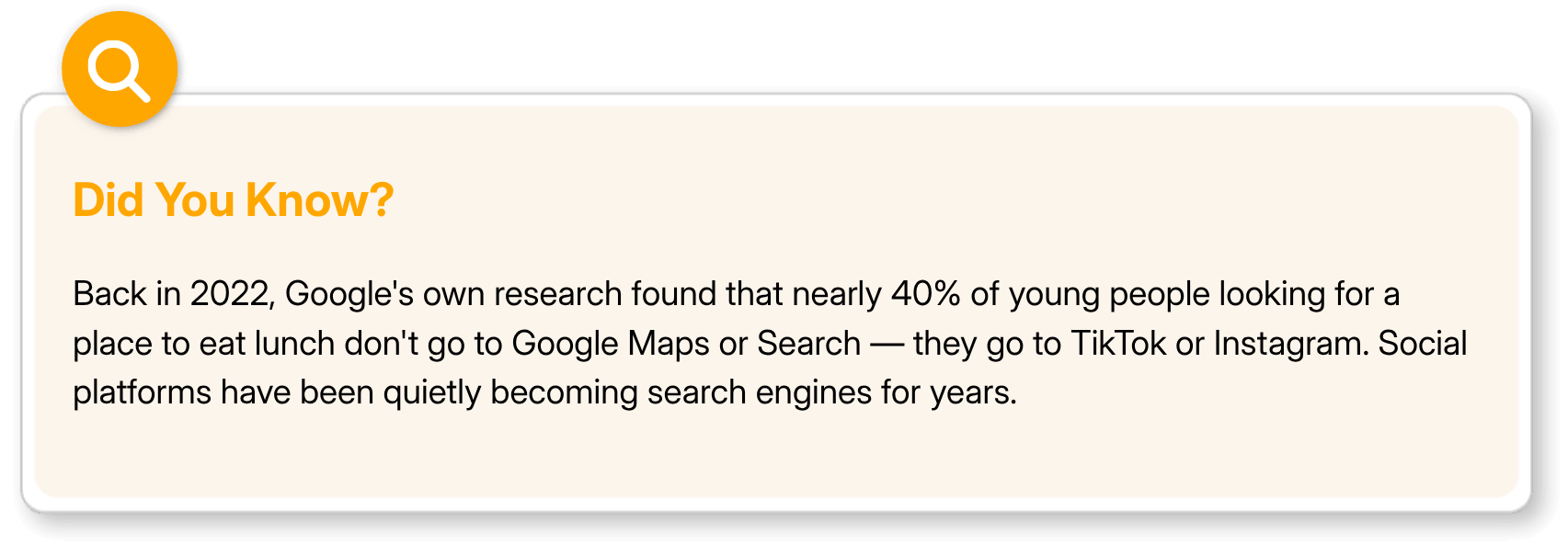
TikTok is no longer just an app for entertainment; it has become a search engine now. Nearly half of U.S. consumers (49%) used TikTok as a search engine in 2026 compared to 41% two years prior. Among Gen Z this habit is stronger: roughly 64% have used TikTok to search. Google research from as far back as 2022 found that 40% of young users preferred social platforms over Google Search or Maps when looking for something like a local restaurant.
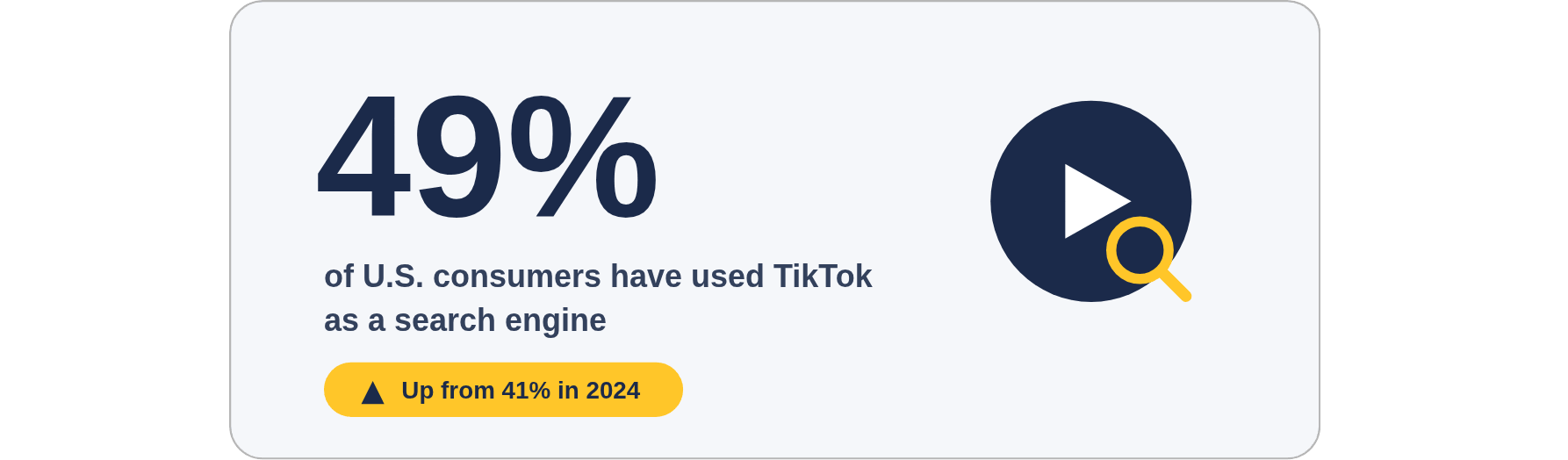
Reality check quick and honest: TikTok is not replacing Google. Among Gen Z, preference for TikTok over Google dropped from 8% to 4% between 2024 and 2026. People use TikTok for discovery searches that are visual and tied to lifestyle and Google for high stakes factual searches. The point is not to abandon Google; buying journeys now start on TikTok and a smart tiktok marketing strategy meets people there.
What Is Metadata for Keywords on TikTok and What Changed Just Recently?
Keyword metadata are the labels TikTok attaches to your videos to decide when to show them in search results and recommendations. Think of these labels as behind-the-scenes tags that tell the platform exactly what your content is really about.
TikTok recently gave creators and brands much more control over these labels. Now you can review keywords attached to your videos and remove terms that don't really fit the content. You can also suggest new ones that work better. TikTok still reviews those suggestions before applying them, though; this guardrails against keyword stuffing and spamming, but for the first time you really have direct control over how your content gets classified.
Why this matters: Better metadata doesn't automatically boost views, but it does improve the quality of your visibility, getting videos in front of people who actually search for them. That's a big advantage because most brands don't even know this feature exists.
How to Do SEO on TikTok: A Playbook with Steps
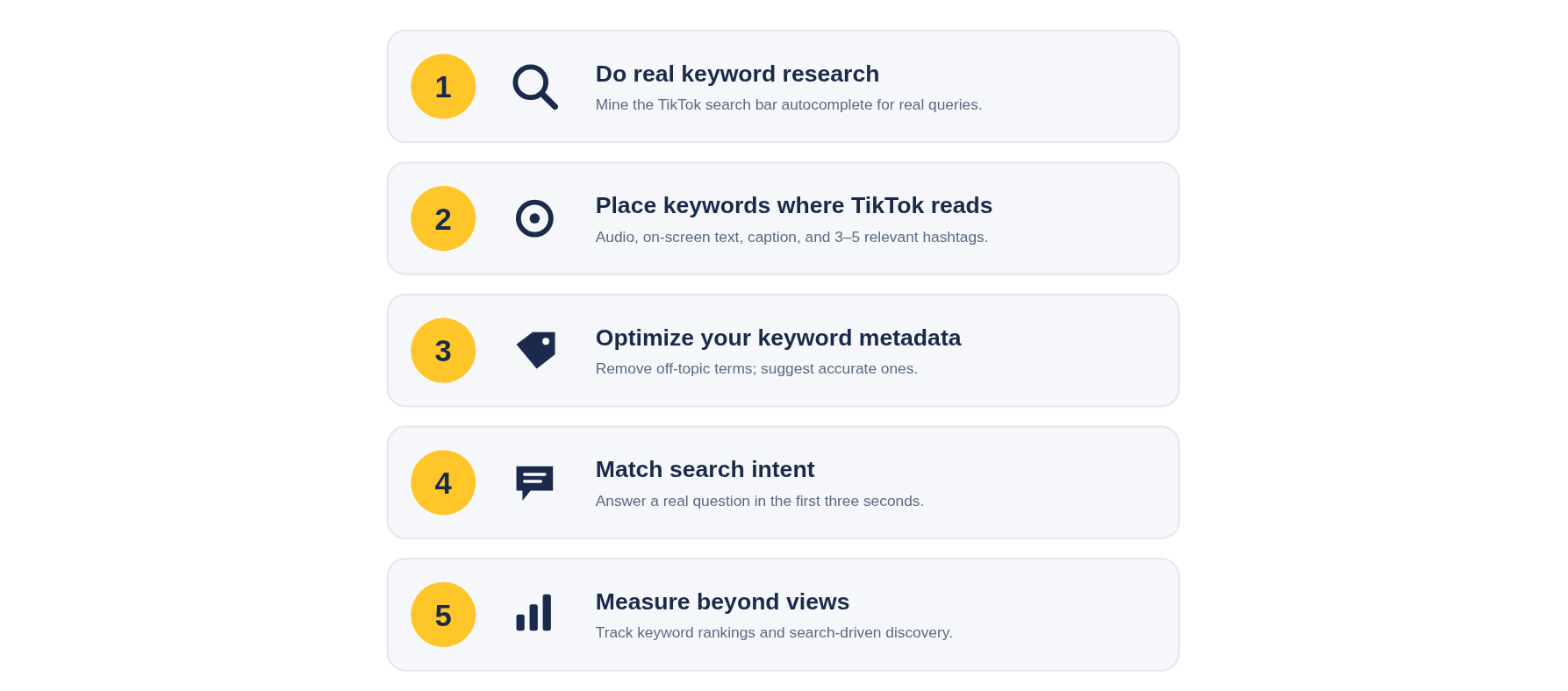
Most guides skip this part. Optimizing for search on TikTok boils down to five steps.
1. Do real research into TikTok keywords. Don't guess; mine the platform itself. Start typing a topic into the TikTok search bar and note suggestions that autocomplete; those are real queries that people actually run. Check prompts that appear on results for searches others did, scan comments for actual questions viewers ask and note which terms competitors rank for. The aim is a short list of exact phrases that your audience actually uses.
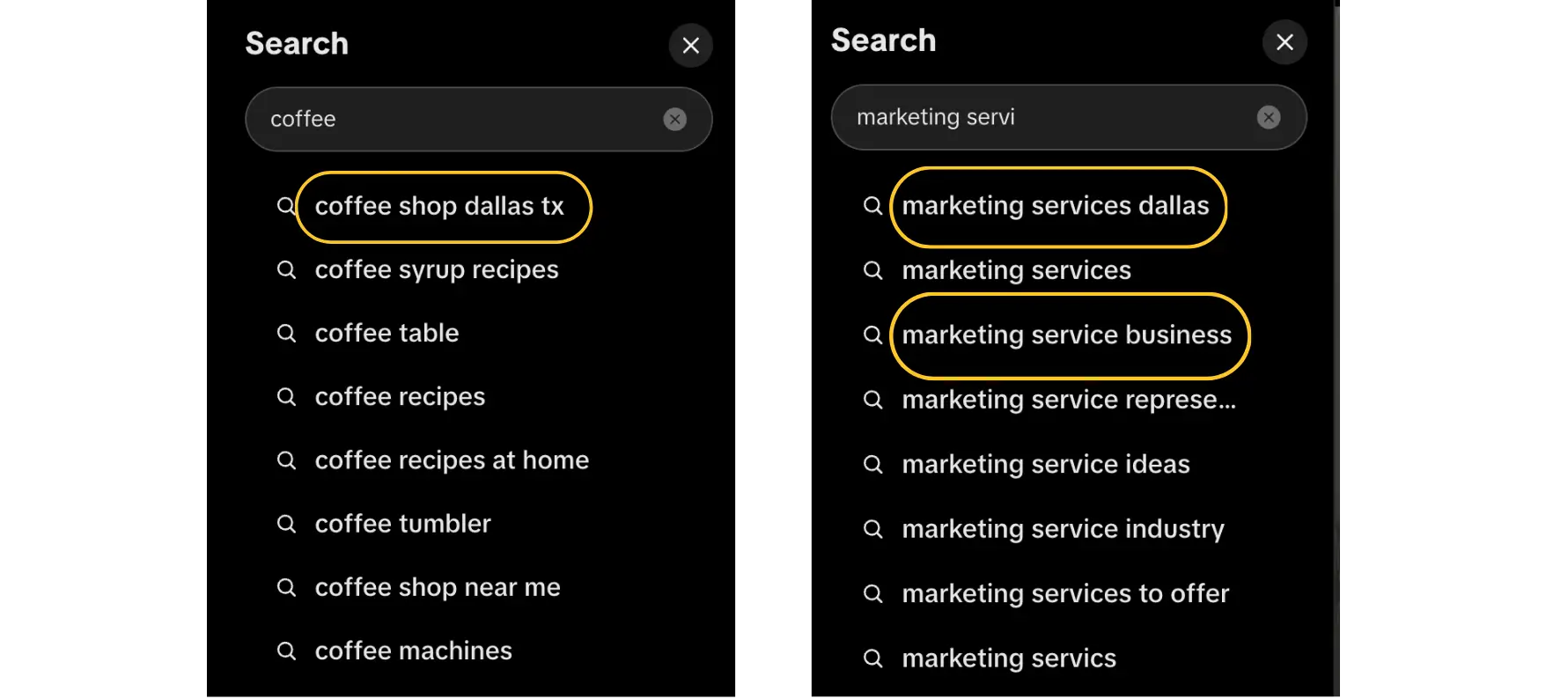
Real searches = your keyword list. TikTok's autocomplete surfaces the exact phrases like "marketing services dallas" your audience is already typing.
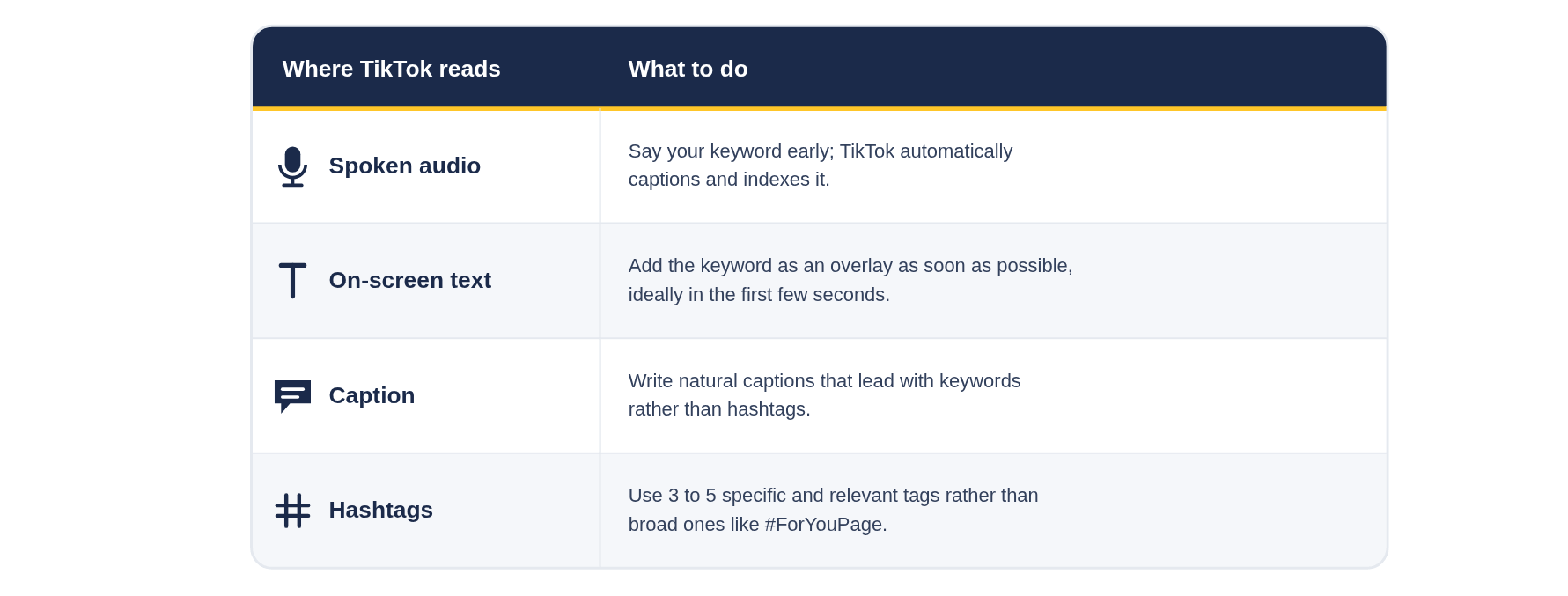
2. Place keywords where TikTok reads them. TikTok looks at multiple places at once so plant your main keyword everywhere it does.
3. Optimize metadata for your video once it goes live. TikTok now lets you review metadata controls: remove keywords that are off topic that bring in the wrong audience, and suggest terms that accurately match the search intent you are targeting. This lever is new and competitors are least likely to use it.
4. Match search intent and answer real questions directly. Search rewards content that actually solves what someone types in. Tutorials, honest reviews, "how to" clips, and local recommendations perform because they correspond to genuine queries. Lead with that answer in the first three seconds and then deliver.
5. Measure beyond views. Views alone won't tell you if search is actually working. Track how your videos rank for target keywords, which search terms are driving discovery, and the quality of the audience engaging with you through search rather than the For You feed. Those signals tell you whether you are reaching searchers or just scrollers.
TikTok SEO Is Part of a Bigger Social Search Shift
Zoom out and TikTok SEO is really just one piece of optimization for search across the different places people now look for information. This includes optimization for TikTok itself, Instagram, and Google's AI answers and assistants like ChatGPT. Signals from one platform feed into others: the language people use to search on TikTok is the same intent that appears in Google and AI tools. Insights into keywords from one platform strengthen all of them, the same shift is already reshaping YouTube and video search.
Local businesses stand to gain especially clearly. When younger consumers open TikTok to look for nearby restaurants, salons, or contractors, having an optimized profile there is no longer optional; it is a discovery channel sitting right alongside your Google Business Profile. Treating search on TikTok, traditional SEO, and AI visibility as one integrated strategy separates brands that are found from brands that are scrolled past.
Final Thoughts
TikTok quietly has become a search engine, and brands optimizing now before competitors catch up will own the queries that are important in their category. Do keyword research, plant those terms everywhere TikTok reads them, use the new metadata controls, and measure what actual search is delivering.
Want to know the visibility of your brand on TikTok, Google, and AI search? Start with a free social audit and we'll show you what you show up for, what you miss, and what to fix first right away.
FAQs
How do you do SEO on TikTok?

To do SEO on TikTok, research the phrases your audience actually searches for (using the autocomplete in TikTok search and the "others searched for" prompts). Put your main keyword in spoken audio, on-screen text, the caption, and 3 to 5 relevant hashtags. Use TikTok's keyword metadata controls to keep associated keywords correct, and create content that directly answers a real search query.
What is keyword metadata on TikTok?
Keyword metadata is the set of keywords TikTok associates with your videos to understand the content and decide when to show them in search and recommendations. Now creators can review this metadata, remove irrelevant keywords, and suggest better ones, subject to a review process.
Is TikTok really used as a search engine?
Yes. Roughly 49% of consumers in the U.S. have used TikTok as a search engine, and Gen Z especially use it a lot, particularly for discovery-driven searches such as product reviews, tutorials, travel tips, and local recommendations.
What is social search optimization?
Social search optimization is the practice of optimizing your content so it is discoverable through searches on social platforms like TikTok and Instagram rather than just traditional search engines, and it increasingly relates to broader visibility through AI search.
How do you measure if SEO on TikTok is working?
Don't just look at raw views; track the ranking of your videos for target keywords, the terms driving discovery, and the quality of the audience engaging through search rather than discovery through the For You feed.
Customers search TikTok now much like they used to search Google by directly typing things like "best coffee shop near me" or "how to fix a leaky faucet" into the app and tapping videos that answer them. If your content isn't optimized to show up for those searches, you are invisible to a huge growing pool of buyers.
How do you actually do SEO on TikTok? You put target keywords where TikTok can read them: spoken words, captions, on-screen text, and a few relevant hashtags, and now metadata you can manage directly too, and base those keywords on what your actual audience is really searching for. That's SEO on TikTok in one sentence. This guide goes into why it matters more than ever and exactly how to do it.
Why SEO Matters More on TikTok
TikTok is no longer just an app for entertainment; it has become a search engine now. Nearly half of U.S. consumers (49%) used TikTok as a search engine in 2026 compared to 41% two years prior. Among Gen Z this habit is stronger: roughly 64% have used TikTok to search. Google research from as far back as 2022 found that 40% of young users preferred social platforms over Google Search or Maps when looking for something like a local restaurant.
Reality check quick and honest: TikTok is not replacing Google. Among Gen Z, preference for TikTok over Google dropped from 8% to 4% between 2024 and 2026. People use TikTok for discovery searches that are visual and tied to lifestyle and Google for high stakes factual searches. The point is not to abandon Google; buying journeys now start on TikTok and a smart tiktok marketing strategy meets people there.
What Is Metadata for Keywords on TikTok and What Changed Just Recently?
Keyword metadata are the labels TikTok attaches to your videos to decide when to show them in search results and recommendations. Think of these labels as behind-the-scenes tags that tell the platform exactly what your content is really about.
TikTok recently gave creators and brands much more control over these labels. Now you can review keywords attached to your videos and remove terms that don't really fit the content. You can also suggest new ones that work better. TikTok still reviews those suggestions before applying them, though; this guardrails against keyword stuffing and spamming, but for the first time you really have direct control over how your content gets classified.
Why this matters: Better metadata doesn't automatically boost views, but it does improve the quality of your visibility, getting videos in front of people who actually search for them. That's a big advantage because most brands don't even know this feature exists.
How to Do SEO on TikTok: A Playbook with Steps
Most guides skip this part. Optimizing for search on TikTok boils down to five steps.
1. Do real research into TikTok keywords. Don't guess; mine the platform itself. Start typing a topic into the TikTok search bar and note suggestions that autocomplete; those are real queries that people actually run. Check prompts that appear on results for searches others did, scan comments for actual questions viewers ask and note which terms competitors rank for. The aim is a short list of exact phrases that your audience actually uses.
Real searches = your keyword list. TikTok's autocomplete surfaces the exact phrases like "marketing services dallas" your audience is already typing.
2. Place keywords where TikTok reads them. TikTok looks at multiple places at once so plant your main keyword everywhere it does.
3. Optimize metadata for your video once it goes live. TikTok now lets you review metadata controls: remove keywords that are off topic that bring in the wrong audience, and suggest terms that accurately match the search intent you are targeting. This lever is new and competitors are least likely to use it.
4. Match search intent and answer real questions directly. Search rewards content that actually solves what someone types in. Tutorials, honest reviews, "how to" clips, and local recommendations perform because they correspond to genuine queries. Lead with that answer in the first three seconds and then deliver.
5. Measure beyond views. Views alone won't tell you if search is actually working. Track how your videos rank for target keywords, which search terms are driving discovery, and the quality of the audience engaging with you through search rather than the For You feed. Those signals tell you whether you are reaching searchers or just scrollers.
TikTok SEO Is Part of a Bigger Social Search Shift
Zoom out and TikTok SEO is really just one piece of optimization for search across the different places people now look for information. This includes optimization for TikTok itself, Instagram, and Google's AI answers and assistants like ChatGPT. Signals from one platform feed into others: the language people use to search on TikTok is the same intent that appears in Google and AI tools. Insights into keywords from one platform strengthen all of them, the same shift is already reshaping YouTube and video search.
Local businesses stand to gain especially clearly. When younger consumers open TikTok to look for nearby restaurants, salons, or contractors, having an optimized profile there is no longer optional; it is a discovery channel sitting right alongside your Google Business Profile. Treating search on TikTok, traditional SEO, and AI visibility as one integrated strategy separates brands that are found from brands that are scrolled past.
Final Thoughts
TikTok quietly has become a search engine, and brands optimizing now before competitors catch up will own the queries that are important in their category. Do keyword research, plant those terms everywhere TikTok reads them, use the new metadata controls, and measure what actual search is delivering.
Want to know the visibility of your brand on TikTok, Google, and AI search? Start with a free social audit and we'll show you what you show up for, what you miss, and what to fix first right away.
FAQs
How do you do SEO on TikTok?
To do SEO on TikTok, research the phrases your audience actually searches for (using the autocomplete in TikTok search and the "others searched for" prompts). Put your main keyword in spoken audio, on-screen text, the caption, and 3 to 5 relevant hashtags. Use TikTok's keyword metadata controls to keep associated keywords correct, and create content that directly answers a real search query.
What is keyword metadata on TikTok?
Keyword metadata is the set of keywords TikTok associates with your videos to understand the content and decide when to show them in search and recommendations. Now creators can review this metadata, remove irrelevant keywords, and suggest better ones, subject to a review process.
Is TikTok really used as a search engine?
Yes. Roughly 49% of consumers in the U.S. have used TikTok as a search engine, and Gen Z especially use it a lot, particularly for discovery-driven searches such as product reviews, tutorials, travel tips, and local recommendations.
What is social search optimization?
Social search optimization is the practice of optimizing your content so it is discoverable through searches on social platforms like TikTok and Instagram rather than just traditional search engines, and it increasingly relates to broader visibility through AI search.
How do you measure if SEO on TikTok is working?
Don't just look at raw views; track the ranking of your videos for target keywords, the terms driving discovery, and the quality of the audience engaging through search rather than discovery through the For You feed.


Summarize with AI
Summarize with AI


Want to be seen everywhere?
Get a free AI-search audit Today!



4.9/5 Ratings!


Don’t miss our revenue growth tips!
Don’t miss our revenue growth tips!
Get expert marketing tips—straight to your inbox, like thousands of happy clients.
Get expert marketing tips—straight to your inbox, like thousands of happy clients.
Relevant Blogs on Organic SEO
Unlock data-driven insights in Organic SEO—explore our featured blogs and skyrocket your revenue before your competitors do.

GEO
Sep 22, 2026
Sep 22, 2026
AI Search Runs on More SEO Than You Think
GEO
Sep 22, 2026
Sep 22, 2026
AI Search Runs on More SEO Than You Think

GEO
Sep 7, 2026
Sep 7, 2026
How to Optimize Content for AI Search Engines: Best Practices
GEO
Sep 7, 2026
Sep 7, 2026
How to Optimize Content for AI Search Engines: Best Practices

GEO
Sep 4, 2026
Sep 4, 2026
How Ecommerce Brands Can Advertise in Google AI Mode?
GEO
Sep 4, 2026
Sep 4, 2026
How Ecommerce Brands Can Advertise in Google AI Mode?


























Ready to speak with an expert?
Data-Driven Marketing Agency That Elevates ROI
1100+
Websites Designed & Optimized to Convert
$280M+
Client Revenue Driven & Growing Strong
Discover how to skyrocket
your revenue today!
Trusted by 1000+ Owners!
Ready to speak with an expert?
Data-Driven Marketing Agency That Elevates ROI
1100+
Websites Designed & Optimized to Convert
$280M+
Client Revenue Driven & Growing Strong
Want to
skyrocket revenue?
Trusted by 1000+ Owners!
Want to skyrocket revenue?
4.9/5 Ratings!
Ready to speak with an expert?
Data-Driven Marketing Agency That Elevates ROI
1100+
Websites Designed & Optimized to Convert
$280M+
Client Revenue Driven & Growing Strong
Discover how to skyrocket
your revenue today!
Trusted by 1000+ Owners!
Call
Call
Call
Meet
Meet
Meet