

What are Responsive Search Ads (RSAs) & How Do They Work?
Responsive Search Ads
Responsive Search Ads let you create adaptable ads that show the most relevant messages to your audience. Google Ads tests different headline and description combinations to find the ones that perform best.



What are Responsive Search Ads?
A Responsive Search Ad is a type of Google ad that changes to fit what a user wants to see. Instead of making just one ad, you give several headlines and descriptions. Google uses its machine learning to try out different mixes. It shows users the options that work the best for them.
How Responsive Search Ads Works?
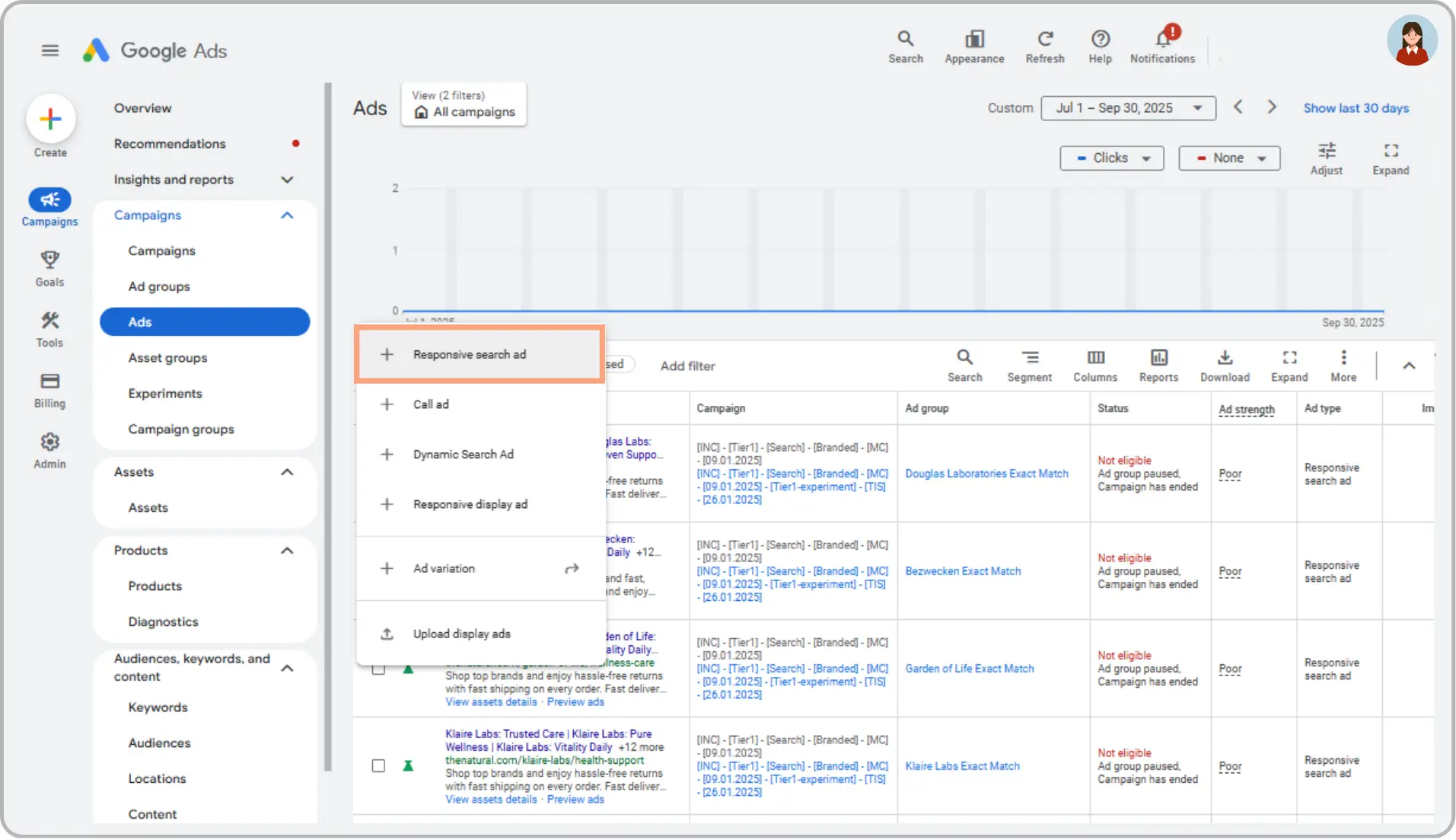
When setting up an RSA, you can:
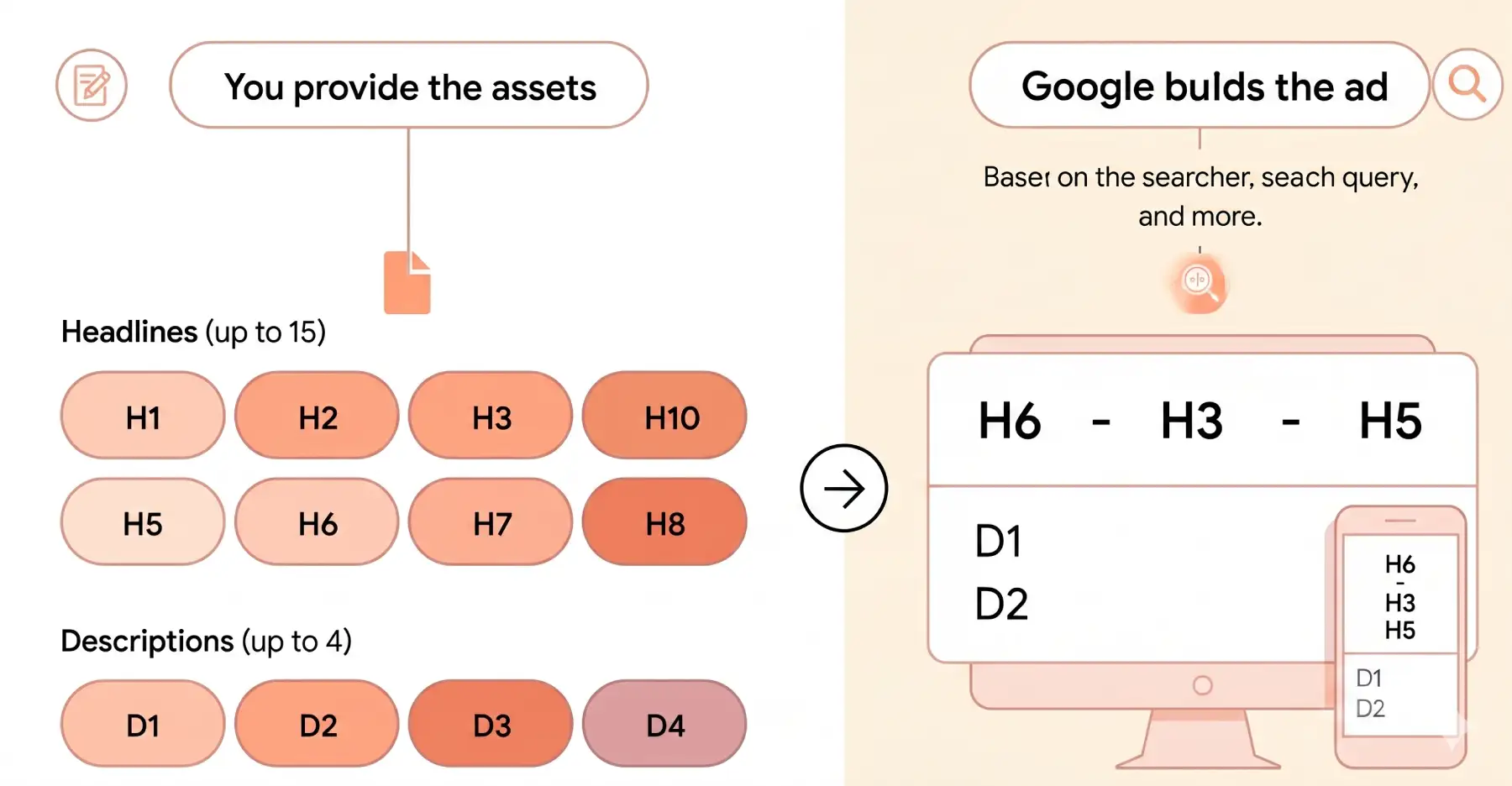
Give up to 15 headlines (up to 30 characters each).
Give up to 4 descriptions (maximum 90 characters each).
Google then mixes these items into ads that can have up to 3 headlines and 2 descriptions at the same time. Over time, it learns which groupings get more clicks or click-through rate (CTR) and more people taking action. It keeps getting better at this to help you reach your goals.
Setting Up RSAs Effectively
To get the most out of RSAs, you should:
Include different headlines. Cover product features, top selling points, brand benefits, and calls to action (CTA).
Use keywords naturally in multiple headlines.
Write descriptions with different focuses like trust signals, promotions, or benefits.
Do not send the same messages again and again so the system gets the most variety to check.
Why Responsive Search Ads Matter in Today's Online Ads?
Responsive Search Ads, are now important for anyone doing digital advertising. They let you use a mix of headlines and text, which shows people more choices. This way, the ads can fit what someone is searching for on Google. RSAs also help companies reach a wider audience because the ads automatically adapt to match what users are searching for. In the end, they make it easier to get your message out and make your ad work better.
RSAs are now the main ad style on Google. They stand out for three big reasons:
Personalization at Scale: They change messages to fit what each person is looking for.
More Auction Opportunities: A mix of different headlines lets your ad show up for more search words.
Reduced Manual Work: Advertisers do not have to spend as much time on A/B testing because Google's AI does the experiments for them.
RSAs are the way that Google is putting AI-first advertising automation at the front. This helps people who advertise to reach users in a smarter way. They can put their time and work into planning instead of spending it on fixing or changing ads by hand.
Aspect | Badly Structured RSAs | Well-Structured RSAs |
|---|---|---|
Headlines | Repetitive or similar headlines with little variation | Diverse, unique headlines covering different angles (benefits, CTAs, USPs) |
Descriptions | Generic or duplicated text that doesn’t add value | Clear, action-oriented descriptions that complement headlines |
Keyword Usage | Overstuffed with keywords or missing main terms | Naturally integrated primary and secondary keywords for relevance |
Ad Strength | Often rated “Poor” or “Average” in Google Ads | Typically rated “Good” or “Excellent” due to variation and quality |
Message Relevance | Doesn’t align with user intent or landing page | Highly relevant to search intent and matches landing page content |
Testing Potential | Limited testing due to repetitive combinations | Enables Google Ads to test multiple strong variations effectively |
Performance | Low CTR, weak conversions, poor engagement | High CTR, better conversions, and stronger engagement |
CTA (Call-to-Action) | Missing or vague calls-to-action | Clear, persuasive CTAs driving user action |
Best Practices for RSA Optimization
Give the maximum number of assets you can. This means 15 headlines and 4 descriptions.
Make each text different and stand-alone, so any mix will work well.
Use dynamic keyword insertion for relevance. Do this carefully and in a way that fits well.
Talk about special deals and trust signals (these can be things like certificates or promises).
Only pin the parts you need (like disclaimers or messages from the brand that must be there).
Common Mistakes to Avoid with RSAs
Making headlines that only do well when placed in a certain order.
Using almost the same headlines and not having many variety.
Over-pinning, which limits Google’s AI testing.
Using keywords in a way that does not feel natural, can make text hard to read.
Not looking at the performance data and the asset ratings in Google Ads.
How to Measure RSA Success?
You can track RSA performance through:
CTR (Click-Through Rate): Measures engagement.
Conversion Rate: Tells you if the ads make people do what you want.
Quality Score & Ad Strength: Google gives you an “Ad Strength” rating. Try to get the best possible score.
Search Term Reports: Look at what search words show your RSA. Use this to make sure your headlines fit these words.
The Bigger Picture: AI-First Advertising
Responsive Search Ads show that Google is now focusing more on using Artificial Intelligence (AI) automation. The platform is switching from fixed ads to ads that can change and learn by using a lot of data. If you choose to use automation, you will save time and get better results. But if you only use manual ads, you can fall behind others.
Final Thoughts
Responsive Search Ads are now needed in search advertising. They are not something you can skip. The way you use a good mix of headlines and descriptions makes a big difference. You should follow the best tips and not make common mistakes. These things help you to get more people, make your ads more useful, and get better results.
It also helps you to save time. Start trying out RSAs today to help your campaigns get set for the future and work with Google's AI.
Frequently Asked Questions (FAQs)
Why are RSAs more effective than traditional static ads?

Static ads rely entirely on the advertiser’s guesswork about what message will resonate. RSAs eliminate this limitation by dynamically adapting to different users, times of day, and search variations. This adaptability increases relevance, delivers more personalized messaging, and improves click-through and conversion rates without constant manual testing.
How many headlines and descriptions should I provide for one RSA?
To help Google's AI find good combinations that work well, you should give the maximum number of items. You can add up to 15 headlines (30 characters each) and up to 4 descriptions (90 characters each). If your items are different from each other, the system can make the ad fit people better.
What is "pinning" in RSAs, and should I use it?
Pinning lets you make sure a headline or description shows up in the spot you choose (Headline 1, Headline 2, and so on) for every ad. You should pin something only when you have to, like for important messages that must be there, a legal text, a brand message, or a special deal for a short time. Pinning too much is a usual mistake because it stops Google’s AI from testing more options and takes away some of the ad’s personal feel.
How do I measure the success and optimize my Responsive Search Ads?
You find out how well you do by looking at things like Click-Through Rate (CTR), Conversion Rate, and Quality Score/Ad Strength. To get better results:
Watch your Ad Strength score in Google Ads. Do what it says to make your ads stronger.
Look at the Asset Report. Switch out headlines and text marked "Low" with new words that stand out.
Go over the Search Term Reports. Make sure your headlines match what people search for.
How should dynamic keyword insertion (DKI) be used in RSAs?
DKI works well when used with moderation. It helps create hyper-relevant ads by inserting a user’s exact search term. However, avoid using DKI in every headline, as it can create awkward or oversized text. Use it for relevance, not as the entire strategy.
How can RSAs improve my Quality Score over time?
Higher ad relevance and stronger expected CTR—two major factors of Quality Score typically improve as RSAs learn which combinations perform best. As Quality Score increases, advertisers often see lower CPCs, higher ad visibility, and more efficient spending.
What role does “Ad Strength” play in RSA performance?
Ad Strength measures how diverse, relevant, and complete your asset list is. While it does not directly determine ranking, higher Ad Strength means Google has more data to work with which improves the chances of finding high-performing combinations that, in turn, boost CTR and Quality Score.



4.9/5 Ratings!

Share this article